Last updated: October 2026
Key takeaways
- Six flows form the foundation of a DTC lifecycle program: welcome, browse abandonment, added-to-cart abandonment, checkout abandonment, post-purchase, and customer win-back.
- Browse, added-to-cart, and checkout represent three different levels of intent and need three different messages.
- Flows need exclusions so a shopper moving toward checkout stops receiving earlier-stage reminders.
- Win-back is about whether a customer is really due to buy again, so the lapse window has to come from real purchase behavior.
- A small set of well-built flows beats a large set with weak logic and overlapping triggers.
For most Shopify DTC brands, six flows form the foundation of a solid lifecycle program: welcome, browse abandonment, cart abandonment, checkout abandonment, post-purchase, and customer win-back.
Together, they cover the most important moments from first signup through repeat purchase.
That doesn't mean every brand needs the exact same setup. The timing, messaging, segmentation, and number of messages should change based on the product and how customers actually buy.
A Klaviyo flow is an automated email or SMS sequence triggered by an action or profile property. One flow can include multiple messages, branches, conditions, and exclusions, so six flows doesn't mean six emails.
What are the six foundational Klaviyo flows?
The six foundational flows are:
| Flow | Trigger | Primary job | Useful first split |
|---|---|---|---|
| Welcome series | Email or SMS signup | Turn a new subscriber into a first-time buyer | Interest, acquisition source, or prior customer status |
| Browse abandonment | Product or collection view with no later cart or order | Bring a shopper back to something they showed interest in | Product or category viewed |
| Added-to-cart abandonment | Added to Cart without starting checkout or ordering | Help resolve hesitation before checkout | First-time vs. returning shopper |
| Checkout abandonment | Started Checkout without ordering | Recover a high-intent shopper | Customer status and cart contents |
| Post-purchase | Placed Order | Help customers succeed and create the next purchase | First vs. repeat order and product purchased |
| Customer win-back | Customer reaches a defined lapse window | Bring previous customers back when they're genuinely due to return | Product purchased, purchase frequency, or customer value |
The important part is not simply having these flows turned on. Each one should reflect the brand's buying cycle.
Why does every DTC brand need a welcome series?
A welcome series is the first opportunity to turn a new subscriber into a customer.
It should deliver whatever the person signed up for, introduce the brand, explain why the product is worth buying, answer common objections, and point them toward the right products.
The discount is only one piece of that.
A good welcome flow might look something like:
- Deliver the signup incentive or promised content.
- Introduce the brand and its main value proposition.
- Feature best sellers or products based on stated interests.
- Add reviews, proof, education, or objection handling.
- Close the initial offer or move the subscriber into regular campaigns.
The more information you collect at signup, the more relevant this can become.
For example, Tomlinson's Feed asks new subscribers what type of pet they have in its pop-up. That answer is stored on the Klaviyo profile and can then be used to recommend more relevant products, which helped produce a 23% welcome flow conversion rate.
The lesson isn't that every brand needs to ask the same question. It's that one useful piece of zero-party data can make the first few messages much more relevant.
Discounting is optional. Whether to use one depends on the brand's margins, positioning, and customer expectations.
How is browse abandonment different from cart abandonment?
The simplest way to think about the three abandonment flows is intent.
- Browse abandonment: They looked at a product or collection but didn't add anything to their cart.
- Added-to-cart abandonment: They selected a product but didn't start checkout.
- Checkout abandonment: They started checkout but didn't place the order.
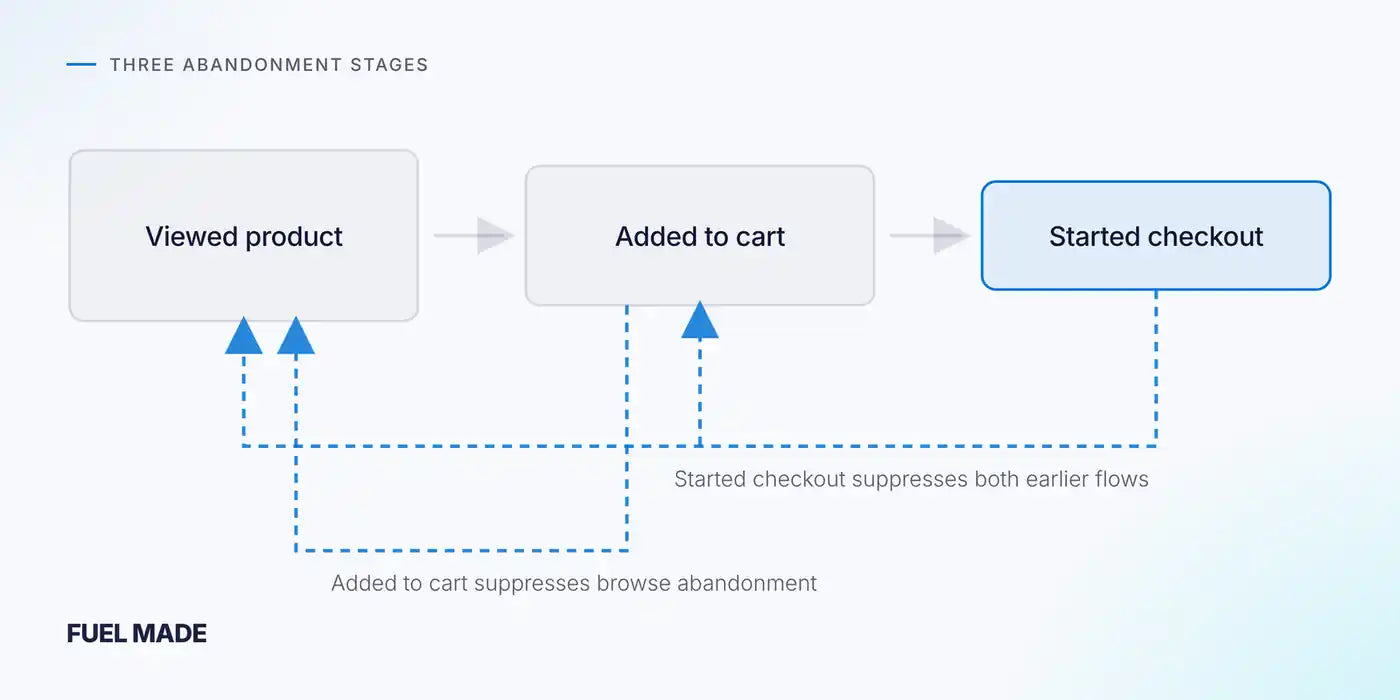
Those are three different moments, so they shouldn't all get the same message.
Browse abandonment should focus on relevance and product education. Someone who viewed a collection may still be figuring out what they want.
Added-to-cart messaging can be more specific. The shopper has already selected something, so the job is to address hesitation and make the next step easier.
Checkout abandonment is the highest-intent stage. At that point, messaging can focus more directly on completing the purchase, while addressing things like reviews, shipping, returns, or other common barriers.
The flows also need to work together.
Someone who starts checkout shouldn't continue receiving browse or added-to-cart reminders. Use exclusions and flow filters to make sure customers move between stages instead of getting messages from all three.
At Fuel Made, we treat browse, added-to-cart, and checkout as separate flows and build cross-flow exclusions between them.
What should an added-to-cart flow do?
An added-to-cart flow should help someone move from “I want this” to “I'm ready to buy this.”
The first message can simply remind the shopper what they selected. Later messages can address objections, add reviews or other proof, and introduce an offer if the economics make sense.
The basic logic is:
- Trigger on Added to Cart
- Exit when the shopper Starts Checkout
- Exit when the shopper Places Order
- Prevent people from repeatedly entering the flow within a short window
- Coordinate with browse and checkout abandonment
The timing depends heavily on the product.
An hour-long delay might make sense for a $30 consumable. It may be completely wrong for a $600 product that requires more consideration.
The same goes for message count. Don't add emails simply because the flow has room for them.
What belongs in an abandoned checkout flow?
Checkout abandonment is where the shopper has already taken the biggest step toward buying without actually completing the order.
That means the messaging can be much more specific.
Rather than sending three versions of “You forgot something,” use the information you already have: what they were buying, whether they've purchased before, reviews, shipping information, returns, and other common objections.
Super7 is a good example.
Its original checkout flow relied on repetitive emails and unrelated product recommendations. We split first-time and returning shoppers, changed the first message to a more conversational plain-text email, changed the CTA to “complete my order,” replaced the product grid with reviews, and spoke more directly to the collector identity of its customers.
That change resulted in a 165% improvement in conversion rate.
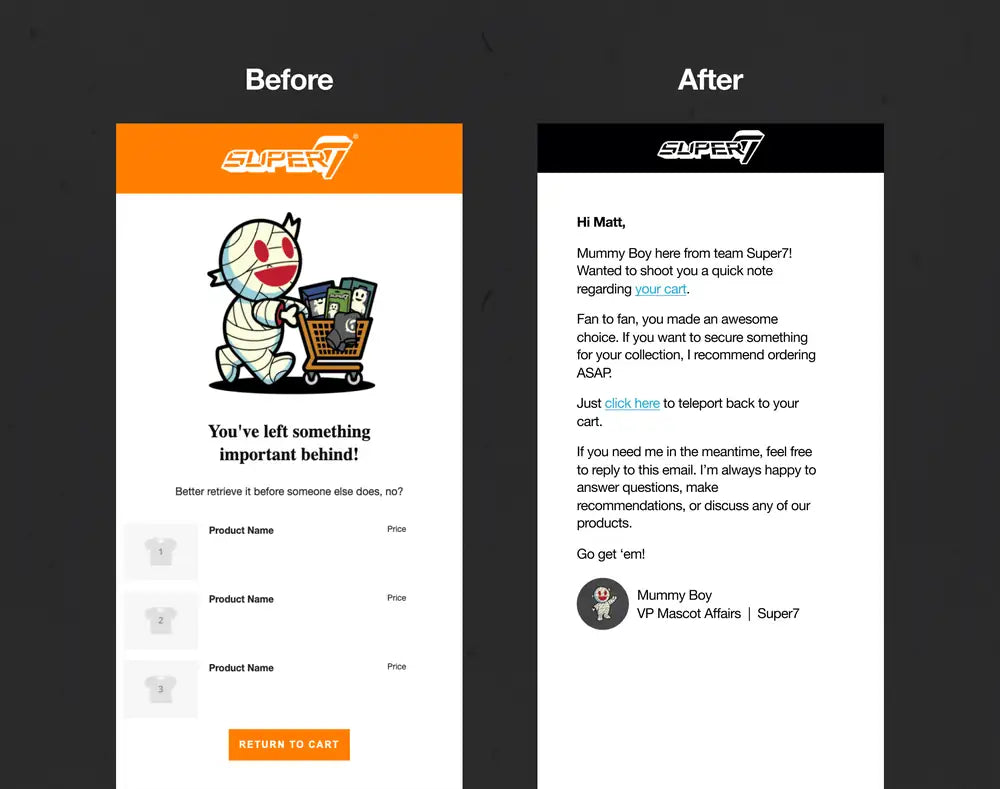
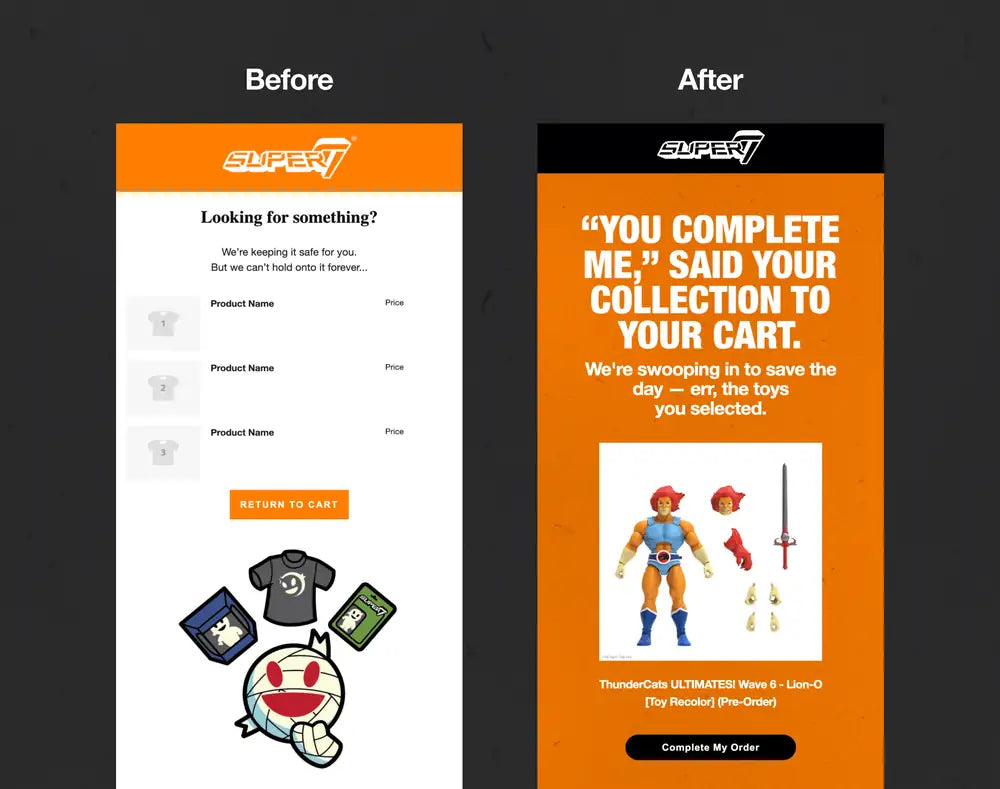
The takeaway isn't to copy the exact flow. It's to make the message fit why that particular customer might still be hesitating.
What should a post-purchase flow include?
The post-purchase flow starts after the sale, but the goal is the next successful customer interaction.
First, help the customer feel good about the purchase. Then help them get value from the product. Only after that should you start thinking about the next sale.
Depending on the brand, a post-purchase sequence might include:
- A thank-you message
- Product setup, care, or usage education
- Social proof to reinforce the customer has made the right choice
- Relevant complementary products
- Loyalty or membership information
The flow should also change based on what the customer bought.
Useful segments include:
- First purchase vs. repeat purchase
- Product or category purchased
- Purchase number or customer milestone
- Subscription status
- Customer value
For example, someone buying their first product shouldn't necessarily receive the same cross-sell as someone who has purchased five times.
SASnola is an example of a brand using post-purchase and retention together. Its program combines review requests, photo tips, physical win-back letters, and membership messaging, with Klaviyo driving 40% of its online revenue.
Why does customer win-back belong in the foundation?
Win-back is different from abandonment because the customer has already bought from you.
The question isn't “How do we recover this purchase?” It's “Is this customer actually due to buy again?”
That’s an important distinction.
A 30-day lapse window might make sense for a product customers use every month. It makes much less sense for a product that people typically replace twice a year.
Build the win-back flow around actual purchase behavior.
You can segment based on:
- Time since last purchase
- Product purchased
- Number of previous orders
- Average purchase frequency
- Customer value
And don't assume every lapsed customer needs a discount. Depending on the product, the better message might be a reminder, new product announcement, education, or a reason to come back.
If the brand doesn't have enough purchase history to identify a meaningful lapse window, it's probably too early for a complicated win-back program.
Which Klaviyo flows should you add next?
Once the six foundational flows are working, look at the behaviors that are specific to the business.
| Add this flow | When the brand needs it |
|---|---|
| Replenishment or refill | Customers use a product on a predictable cycle |
| Subscription conversion or reactivation | The catalog supports recurring orders |
| Back in stock | Out-of-stock demand is meaningful |
| Review request | Customers need time to experience the product |
| Loyalty and rewards | The brand has a meaningful loyalty program |
| Sunset | Disengaged profiles are affecting list health or sending costs |
| Predictive cross-sell | There is enough purchase data to identify likely next products |
These are additions, not prerequisites.
The right time to add them depends on traffic, purchase frequency, product type, customer data, and the quality of the foundational flows.

How should you prioritize Klaviyo flows?
Start with the customer moments you're currently missing.
Before building another automation, make sure the basics are working:
- Confirm tracking, consent, deliverability, and Shopify event data.
- Map the six foundational customer moments.
- Check triggers, filters, exclusions, and flow overlap.
- Look at eligible volume and revenue opportunity.
- Build the message strategy and creative.
- QA the flow with live events on desktop and mobile.
- Measure performance and revise once there is enough data.
There's no prize for having the most flows in an account.
A smaller number of well-built flows is more useful than a large collection of automations with weak logic, generic messaging, or overlapping triggers.
And not every brand needs the same complexity. A low-volume brand may not have enough data to justify five branches inside a niche flow. A high-AOV product may need much more time between messages than a replenishable product.
What makes a Klaviyo flow effective?
Good flow strategy comes down to six things:
-
The right trigger
The flow starts because the customer actually did something meaningful. -
Clear exit conditions
People leave the flow when their behavior changes. -
Useful segmentation
Segments should change the message, not just exist for the sake of segmentation. -
Appropriate timing
The delays should match the product and the customer's decision-making process. -
Relevant content
The message should answer the question the customer is likely asking at that stage. -
Meaningful measurement
Look beyond opens. Track clicks, conversion, revenue, unsubscribes, and other metrics that show whether the flow is doing its job.
Email and SMS should also be considered together. Smart Sending, campaign exclusions, channel preferences, and flow-specific rules can prevent customers from receiving too many messages at once.
One simple operational habit helps, too: use consistent naming for flows, messages, segments, and events. It makes the account much easier to audit and hand off when someone else joins the team.
Frequently asked questions
How many Klaviyo flows should a DTC brand have?
Six foundational flows are a good starting point: welcome, browse abandonment, added-to-cart abandonment, checkout abandonment, post-purchase, and customer win-back.
The total number can grow from there based on the catalog, purchase cycle, traffic, subscriptions, loyalty program, and integrations.
Which Klaviyo flow should a brand build first?
Start with the biggest uncovered customer moment rather than following a universal order.
For a new program, welcome and checkout abandonment often deserve early attention because they address two very different but important points in the customer journey. An audit of tracking, event data, and existing coverage should determine what comes first.
What's the difference between cart and checkout abandonment?
Added to Cart fires when someone adds an item to their cart but doesn't move into checkout.
Started Checkout fires after the shopper enters checkout.
Because the shopper has shown a different level of intent, the two flows should have different messaging and should suppress one another when the customer's behavior changes.
How many emails belong in a Klaviyo flow?
There's no universal number.
The right number depends on the customer's decision-making process, available content, trigger volume, and performance. More emails don't automatically make a flow better.
Should every Klaviyo flow include SMS?
No.
SMS makes sense when the message is timely, useful, concise, and the customer has given the appropriate consent. Sending the same message by email and SMS simply because both channels are available can create unnecessary frequency.
How often should Klaviyo flows be reviewed?
Monitor them continuously and do a deeper review whenever something changes that could affect customer behavior or the underlying data.
That includes a major offer, catalog change, rebrand, platform migration, new integration, retired product, or changes to Shopify/Klaviyo events.
Fuel Made works with Shopify and Shopify Plus brands on Klaviyo email and SMS programs. If you want to identify missing flow coverage, weak logic, or underperforming customer moments in your account, talk with our team.